Tag: personal development

  • The Planner System That Actually Works After 50

    Preview

    Somewhere in your house is a planner graveyard. The Full Focus Planner you bought in January and abandoned by February. The bullet journal that turned into a glorified grocery list. The gorgeous, color-coded planner that looked beautiful on your desk and told you absolutely nothing useful about what to do next.

    You’re not bad at planning. Most planners are just built for a version of you that doesn’t exist — someone with an uninterrupted morning, zero surprises, and the patience to color-code a life that keeps changing on them.

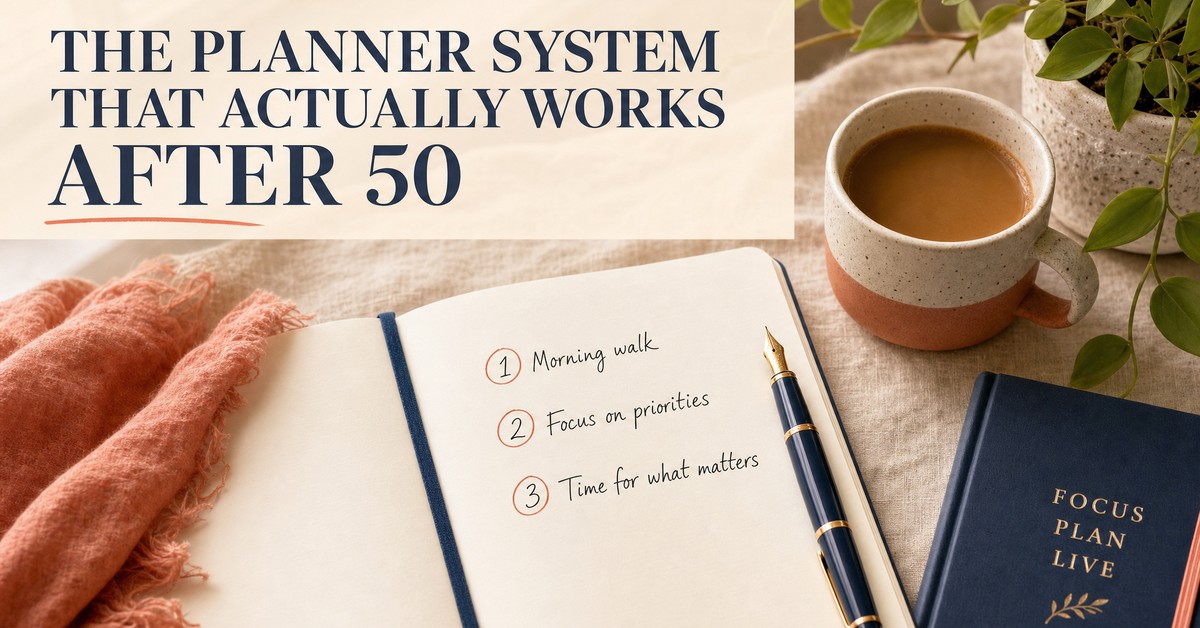
    One writer actually tested 10 different productivity planners over 90 days, and the conclusion was blunt: most of them fail for the same reason. They’re designed for an ideal, tidy version of a person, not the actual disorganized reality most of us are managing. The planner that worked best in that 90-day test wasn’t the prettiest or the most detailed. It was the simplest — just three visible tasks a day, written down where you’d actually see them.

    That’s the whole system. Here’s how to build your own version of it.

    1. One Page, Not a Book

    You don’t need a planner with twelve sections and a goals worksheet. You need one page you’ll actually open. If setting up the system takes longer than using it, you’ll abandon it by week three — which, statistically, is exactly when most planners end up back in a drawer.

    2. Three Tasks, Visible, Not Buried

    Not a to-do list of eleven things that guarantees you’ll feel behind by 10am. Three tasks. Written somewhere you’ll actually see them — not buried in an app notification you’ll swipe away without reading. If you finish all three, anything else is a bonus, not an obligation.

    3. Done at the End, Not Perfect at the Start

    The planners that fail are the ones that ask you to plan your whole week perfectly on Sunday night. Life after 50 — especially if you’re building a business, adjusting to retirement, or both — doesn’t hold still that long. Plan loosely. Adjust daily. The goal is finishing the day having done your three things, not having predicted it flawlessly in advance.

    Why This Works When the Fancy Ones Don’t

    You have 1440 minutes today, same as everyone else. The planners that fail try to account for all of them. The ones that actually work just protect three specific pockets of that time and let the rest sort itself out. That’s not a lesser system — it’s the one that survives contact with an actual Tuesday.

    If you want a starting point, grab any notebook you already own, write today’s date at the top, and list three things. That’s it. That’s the planner. You can make it prettier later, once you’ve proven to yourself it’s a habit worth keeping.

    Source: Insights adapted from Anshul Kumar, “I Tested 10 Productivity Planners for 90 Days. Here’s My Honest Verdict,” Substack.
  • 4 Self Care Routines That Actually Fit Into a Busy Woman’s Day

    Let’s be honest about something first: most self-care advice is written for people with an empty afternoon and a bathtub. Bubble baths, candlelit journaling sessions, hour-long yoga flows — lovely in theory, useless on a Tuesday when you’re juggling a business you’re still figuring out, a calendar that somehow filled itself back up after retirement, and 1440 minutes that keep disappearing before lunch.

    Self-care doesn’t have to be a production. It just has to actually happen.

    Counselors typically break self-care into five categories — physical, emotional, mental, social, and spiritual — and the point isn’t to do all five perfectly every day. It’s to have a few reliable moves in each category that take minutes, not hours, so you’re not waiting for a free weekend that never comes.

    Here are 4 that actually fit into a full day.

    1. The 10-Minute Movement Reset

    You don’t need a workout. You need blood flow. A short walk around the block, a few minutes of stretching next to your desk, or just standing up and moving your body between tasks counts as real physical self-care — not a lesser version of “real” exercise. The goal is recharging, not training for something.

    When to use it: Right when you notice you’ve been sitting and staring at the same screen for too long to be productive anymore.

    2. The Two-Minute Mental Boundary

    Not every request deserves an immediate yes, and not every open tab deserves your attention right now. Mental self-care often looks less like meditation and more like closing something — a browser tab, a conversation, a “let me get back to you.” Give yourself two minutes to decide what actually needs your focus today before you hand it out to whoever asked first.

    When to use it: Before you agree to anything that isn’t already on today’s short list.

    3. The Real Connection Check-In

    Scrolling isn’t social self-care, even though it feels like it fills the same slot. A quick call or text to one actual person — a friend, your spouse, someone who knows the version of you that exists outside of work — does more for you in five minutes than an hour of passive scrolling ever will.

    When to use it: Whenever you catch yourself reaching for your phone out of boredom instead of intention.

    4. The Sixty-Second Grounding Pause

    This is the smallest one, and it might matter the most. Before you start your day — or before you close it out — take sixty seconds to just notice how you actually feel, without immediately trying to fix or plan around it. No journal required, though if you’ve been doing the journal prompts from the last post, this pairs well with that practice.

    When to use it: First thing in the morning, or the last thing before you close your laptop for the day.

    The Actual Point

    None of these require a spa day, a retreat, or a Sunday with nothing on the calendar. They require noticing that you have 1440 minutes today, and that a handful of them — spent on purpose — go a lot further than the ones that just slip by while you’re waiting to “have time” for yourself later.

    Later isn’t a plan. Sixty seconds today is.

    Source: Adapted from “The Best Types of Self Care for a Busy Schedule,” Petrohilos Counseling.